Saturday, April 15, 2017

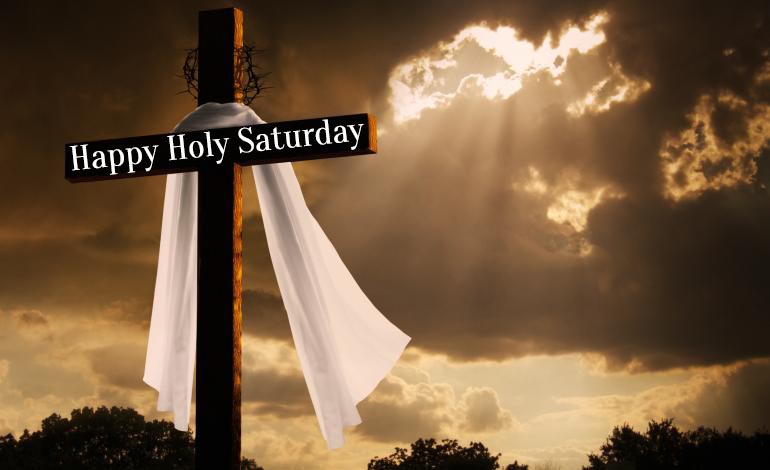
HOLY SATURDAY


Holy Saturday. Holy Saturday commemorates the day that Jesus Christ lay in the tomb after his death, according to the Christian bible. It is the day after Good Friday and the day before Easter Sunday. It is also known as Easter Eve, Easter Even, Black Saturday, or the Saturday before Easter.

This was the only sign Jesus gave that He was the promised Messiah: “For as Jonah was three days and three nights in the belly of the great fish, so will the Son of Man be three days and three nights in the heart of the earth”.

On the first day of the week, very early in the morning, the women took the spices they had prepared and went to the tomb. They found the stone rolled away from the tomb, but when they entered, they did not find the body of the Lord Jesus. While they were wondering about this, suddenly two men in clothes that gleamed like lightening stood beside them. In their fright the women bowed down with their faces to the ground, but the men said to them, "Why do you look for the living among the dead? He is not here; he has risen! Remember how he told you, while he was still with you in Galilee: 'The Son of Man must be delivered into the hands of sinful men, be crucified and on the third day be raised again.'"

Where was Jesus for the three days between His death and resurrection?

We know from Jesus’ statement to the thief that when one dies they enter the presence of God immediately. Luke 23:42 states, “Truly I say to you, today you shall  be with Me in Paradise.” This statement also tells us that Jesus went to His Father upon death.

Beyond this we know very little about where Jesus was for three days. One must be careful not to read too much detail into a parable or story. The issue in Jesus recounting the story of Jonah was to relate to His anticipated three days of being dead. Reading Jonah 2:2, some translations say, “from the depth of Sheol”, another translation says, “from the depth of hell”, still another says, “from the grave.” What is clear is that Jonah assumed he was a dead man inside the fish as he prayed.

Later, in Jonah 2:6 we are told his “life was brought up from the pit.” Some interpreters assume that this is a reference to hell. However, a very simple interpretation of the Bible takes this as a reference to death, the imagery is the grave. Sheol is not hell; to the Hebrew mind it is death; a place where the soul waits for resurrection and judgment. The context of Jonah 2:6 is “the earth with its bars was around me forever.” He is using imagery to say he felt just the same as if his body was buried in the earth (grave) and he was locked there forever.

There are other passages that are used to suggest that Jesus went to hell during the three days His body was in the tomb. If one wants to believe that He went to hell, then the verses can suggest it. However, if the verses are simply taken one-by-one, they do not support that belief. Let’s look at those verses.

  • Psalm 16:10 says, “Because you will not abandon me to the grave, nor will you let your Holy One see decay.” It relates “grave” and “pit.” Hebrew poetic parallelism means the two words are to be taken as one idea—the simple grave, a pit in the earth where flesh decays.

  • Ephesians 4:8-10 contains the statement, “‘He ascended,’ what does it mean except that He also had descended into the lower parts of the earth’?” Some interpret “the lower parts of the earth” as hell. However, again, the simple reading of this verse is that Jesus ascended into the heavens after first having descended into the earth below, the grave. In fact, the Greek language here can either be read “the lower region of earth” or “the lower region, earth.” Either way, it is a simple contrast of descending to earth which is a lower region than the heavens and does not provide any detail to suggest to the reader that He had been to Hell.

  • I Timothy 3:16 tell us that Jesus “was seen by angels.” Indeed, He was seen by angels as clearly suggested in all three synoptic gospels just after His resurrection (Matthew 28:6; Mark 16:6; Luke 24:6). Those who already assume that Jesus went to hell want this to mean “fallen angels” whom He preached to during the three days of death. There is no reason to assume this at all.


The passage of Scripture most referred to by those holding to the hell theory is 1 Peter 3:18-20. “For Christ also died for sins once for all, the just for the unjust, in order that He might bring us to God, having been put to death in the flesh, but made alive in the spirit; in which also He went and made proclamation to the spirits now in prison, who once were disobedient, when the patience of God kept waiting in the days of Noah, during the construction of the ark, in which a few, that is, eight persons, were brought safely through the water.” The words they point to are “in which also He went and made proclamation to the spirits now in prison.” Supposedly, Jesus descended to hell and preached to lost souls. But why? Nowhere in the Bible is there any statement that a lost soul who has died can have a second chance. Did Jesus go to hell just to torment the lost souls more? There is a more reasonable interpretation of this passage.

Jesus was put to death in the flesh, but was made alive by the Spirit. The word “made alive” is passive, meaning that someone other than Jesus made Him alive. Either Jesus was made alive by the Spirit, or in His spirit. Either way the Spirit must have been involved. Then the passage continues by telling us who these souls in prison are, they are those who did not listen to Noah (who was preaching repentance in the Spirit’s power to the world at the direction of God). 

Thus, the same Spirit who raised Jesus as a testimony “in order that He might bring us to God” also had spoken in Noah’s day to those souls now in prison; and they are in prison because they did not listen at the time of the preaching. In fact, only eight people listened and were saved—” brought safely through the water.” The idea of “prison” is figurative. The Bible does indicate that lost souls are removed and restrained in Luke 16:26: “And besides all this, between us and you there is a great chasm fixed, in order that those who wish to come over from here to you may not be able, and that none may cross over from there to us.”

Nowhere in the Bible does it say that Jesus went to hell during the three days. Actually, very little is said about what went on. The normal assumption is that Jesus’ fleshly body remained in the tomb, just as ours will remain in the grave. He went to the presence of the Father, and three days later the Spirit resurrected His body (in the same way that our bodies will be resurrected—the first-born from the dead in Col. 1:18). The difference is that God did not allow Jesus’ body to decay (exactly the promise found in Psalm 16:10 above.)

Answer: 1Peter 3:18–19 says, “Christ also suffered once for sins, the righteous for the unrighteous, that he might bring us to God, being put to death in the flesh but made alive in the spirit, in which he went and proclaimed to the spirits in prison” (ESV). The word spirit refers to Christ’s spirit. The contrast is between His flesh and spirit, and not between Christ’s flesh and the Holy Spirit. Christ’s flesh died, but His spirit remained alive.

1 Peter 3:18–22 describes a necessary link between Christ’s suffering (verse 18) and His glorification (verse 22). Only Peter gives specific information about what happened between these two events. The KJV says that Jesus “preached” to the spirits in prison (verse 19). However, the Greek word used is not the usual New Testament word for preaching the gospel. It simply means “to herald a message”; the NIV translates it as “made proclamation.” Jesus suffered and died on the cross, His body being put to death. But His spirit was made alive, and He yielded it to the Father (Luke 23:46). According to Peter, sometime between Jesus’ death and His resurrection Jesus made a special proclamation to “the spirits in prison.”

In the New Testament, the word spirits are used to describe angels or demons, not human beings. In 1 Peter 3:20, Peter refers to people as “souls” (KJV). Also, nowhere in the Bible are we told that Jesus visited hell. Acts 2:31 says that He went to Hades (New American Standard Bible), but Hades is not hell. Hades is a term that refers, broadly, to the realm of the dead, a temporary place where the dead await resurrection. Revelation 20:11–15 in the NASB and the NIV makes a clear distinction between the Hades and the lake of fire. The lake of fire is the permanent, final place of judgment for the lost. Hades is a temporary place for both the lost and the Old Testament saints.

Our Lord yielded His spirit to the Father, died physically, and entered paradise (Luke 23:43). At some time between His death and resurrection, Jesus also visited a place where He delivered a message to spirit beings (probably fallen angels; see Jude 1:6); these beings were somehow related to the period before the flood in Noah’s time (1 Peter 3:20). Peter does not tell us what Jesus proclaimed to the imprisoned spirits, but it could not be a message of redemption since angels cannot be saved (Hebrews 2:16). It was probably a declaration of victory over Satan and his hosts (1 Peter 3:22; Colossians 2:15). Ephesians 4:8–10 also seems to give a clue regarding Jesus’ activities in the time between His death and resurrection. Quoting Psalm 68:18, Paul says about Christ, “when he ascended on high, he took many captives” (Ephesians 4:8). The ESV puts it that Christ “led a host of captives.” The reference seems to be that, in paradise, Jesus gathered all the redeemed who were there and took them to their permanent dwelling in heaven.

All this to say, the Bible isn’t entirely clear what exactly Christ did for the three days between His death and resurrection. From what we can tell, though, He comforted the departed saints and brought them to their eternal home, and He proclaimed His victory over the fallen angels who are kept in prison. What we can know for sure is that Jesus was not giving anyone a second chance for salvation; we face judgment after death (Hebrews 9:27), not a second chance. Also, He was not suffering in hell; His work of redemption was finished on the cross (John 19:30).


In Christ,
Janet Irene Thomas
Director, Playwright, Producer,
Gospel Lyricist, Screenwriter
Founder/CEO
Bible Stories Theatre of Fine &
Performing Arts


Friday, April 14, 2017

GOOD FRIDAY


 WHEN WRATH AND MERCY MET AT THE CROSS.


REMEMBERING THE CRUCIFIXION

On a dark Friday two thousand years ago, Jesus of Nazareth was crucified. Powerful members of the religious, political, and military communities colluded to strip him naked, mock him publicly, and crucify him. Yet two millennia later, Christians—who believe that Jesus is the Son of God—celebrate that dark day by calling it Good Friday.


On the Christian Holy Day known as Good Friday, observed the Friday before Easter, Christians commemorate the passion, or suffering, and death of Jesus Christ on the cross. Good Friday, which is the end of Holy Week, as the week before Easter is called, concludes with the remembrance of the tortuous death Christ endured to bring salvation and everlasting life to his people. On that day, he was beaten, whipped, spat upon and cursed at. He carried his cross to the top of a mountain (Golgotha/Calvary outside of Old Jerusalem).

His death that day not only fulfilled the Old Testament scriptures about his sacrifice, but also set the stage for his resurrection on Easter. The beating he took on Good Friday fulfilled the prophesy in Isaiah 53 that states "He was wounded for our transgressions, he was bruised for our iniquities: the chastisement of our peace was upon him, and with his stripes we are healed."

It does seem odd to refer to anybody’s death as "good." Yet, God’s good plan is often counterintuitive: As Jesus says, “He who finds his life will lose it, and he who loses his life will find it; “the first are the last and the last are the first” (Mark 10:31).   

Think on this: even while powerful men were conspiring to kill the Son of God, God himself was acting to save the world from itself, once and for all. Even while the world’s authorities were conspiring to perpetrate history’s greatest evil, God was working to bring about history’s greatest good.  Take note of the heart of the Son of God as he hung dying on the cross for our sins.


Biblical accounts

According to the accounts in the Gospels, Jesus agonized on the cross for six hours. During his last three hours on the cross, from noon to 3 pm, darkness fell over the whole land, and Jesus spoke from the cross, quoting the messianic Psalm 22: "My God, my God, why have you forsaken me?"

  • Jesus Christ made seven final statements during his last hours on the cross. As much as possible, given the approximate sequence of events as portrayed in the Gospels, these seven last words of Christ are presented here in chronological order.

1) JESUS SPEAKS TO THE FATHER
Luke 23:34
Jesus said, "Father, forgive them, for they do not know what they are doing." (NIV)
During his excruciating suffering, the heart of Jesus was focused on others rather than himself. Here we see the nature of his love -- unconditional and divine.

2) JESUS SPEAKS TO THE CRIMINAL ON THE CROSS
Luke 23:43
"I tell you the truth, today you will be with me in paradise." (NIV)
One of the criminals who was crucified with Christ had recognized who Jesus was and expressed faith in him as Savior. Here we see God's grace poured out through faith, as Jesus assured the dying man of his forgiveness and eternal salvation.

3) JESUS SPEAKS TO MARY AND JOHN
John 19:26-27
When Jesus saw his mother there, and the disciple whom he loved standing nearby, he said to his mother, "Dear woman, here is your son," and to the disciple, "Here is your mother." (NIV)
Jesus, looking down from the cross, was still filled with the concerns of a son for the earthly needs of his mother.
None of his brothers were there to care for her, so he gave this task to the Apostle John. Here we clearly see Christ's humanity.

4) JESUS CRIES OUT TO THE FATHER
Matthew 27:46 (also Mark 15:34)
And about the ninth hour Jesus cried out with a loud voice, saying, “Eli, Eli, lama sabachthani?” that is, “My God, My God, why have You forsaken Me?” (NKJV)
In the darkest hours of his suffering, Jesus cried out the opening words of Psalm 22. And although much has been suggested regarding the meaning of this phrase, it was quite apparent the agony Christ felt as he expressed separation from God. Here we see the Father turning away from the Son as Jesus bore the full weight of our sin.

5) JESUS IS THIRSTY
John 19:28
Jesus knew that everything was now finished, and to fulfill the Scriptures he said, "I am thirsty." (NLT)
Jesus refused the initial drink of vinegar, gall, ​and myrrh (Matthew 27:34 and Mark 15:23) offered to alleviate his suffering. But here, several hours later, we see Jesus fulfilling the messianic prophecy found in Psalm 69:21.

6) IT IS FINISHED
John 19:30
... he said, "It is finished!" (NLT)
Jesus knew he was suffering the crucifixion for a purpose. Earlier he had said in John 10:18 of his life, "No one takes it from me, but I lay it down of my own accord. I have authority to lay it down and authority to take it up again. This command I received from my Father." (NIV) These three words were packed with meaning, for what was finished here was not only Christ's earthly life, not only his suffering and dying, not only the payment for sin and the redemption of the world -- but the very reason and purpose he came to earth was finished.

His final act of obedience was complete. The Scriptures had been fulfilled.

7) JESUS' LAST WORDS
Luke 23:46
Jesus called out with a loud voice, "Father, into your hands I commit my spirit." When he had said this, he breathed his last. (NIV)
Jesus closes with the words of Psalm 31:5, speaking to the Father. We see his complete trust in the Father. Jesus entered death in the same way he lived each day of his life, offering up his life as the perfect sacrifice and placing himself in God's hands.


With a loud cry, Jesus gave up his spirit. There was an earthquake, tombs broke open, and the curtain in the Temple was torn from top to bottom. This tear, according to Christian tradition, signified a removal of restriction of the common Jews from the Temple's "Holiest of Holies", and that God's people now could, themselves, communicate directly with their advocate before God, Jesus the Christ, rather than needing the Temple's High Priest as an intercessor. The centurion on guard at the site of crucifixion declared, "Truly this was God's Son!" (Matthew 27:45–54)

Joseph of Arimathea, a member of the Sanhedrin and secret follower of Jesus, who had not consented to his condemnation, went to Pilate to request the body of Jesus (Luke 23:50–52). Another secret follower of Jesus and member of the Sanhedrin named Nicodemus brought about a hundred-pound weight mixture of spices and helped wrap the body of Jesus (John 19:39–40). Pilate asked confirmation from the centurion of whether Jesus was dead (Mark 15:44). A soldier pierced the side of Jesus with a lance causing blood and water to flow out (John 19:34), and the centurion informed Pilate that Jesus was dead (Mark 15:45).


Joseph of Arimathea took Jesus' body, wrapped it in a clean linen shroud, and placed it in his own new tomb that had been carved in the rock (Matthew 27:59–60) in a garden near the site of crucifixion. Nicodemus (John 3:1) also brought 75 pounds of myrrh and aloes, and placed them in the linen with the body, in keeping with Jewish burial customs (John 19:39–40). They rolled a large rock over the entrance of the tomb (Matthew 27:60). Then they returned home and rested, because Shabbat had begun at sunset (Luke 23:54–56). Matt. 28:1 "After the Shabbat, at dawn on the first day of the week, Mary Magdalene and the other Mary went to look at the tomb". i.e. "After the Sabbath, at dawn on the first day of the week, .......". "He is not here; he has risen, just as he said..........”. (Matt. 28:6) On the third day, which is now known as Easter Sunday (or Pascha), Jesus rose from the dead.


 It is indeed a Good Friday because_

1. On the cross, Jesus suffered so that we would not have to suffer.
2. Through the cross, we can be reconciled to God and each other.
3. Because of the cross and resurrection, we have hope for the future.

The Bible connects Jesus’ crucifixion with his resurrection. After Jesus suffered on the cross, he was buried, but on the third day he rose from the grave! When he rose from the dead, he not only confirmed his divinity but declared that he would return one day to make things right. He will return to disestablish evil, sin, and death from their artificial throne, and establish himself as the true King over a kingdom characterized by justice, peace, and love (Rev 21-22).

In Christ,

Janet Irene Thomas
Director, Playwright, Producer,
Gospel Lyricist, Screenwriter
Founder/CEO
Bible Stories Theatre of Fine &
Performing Arts

Tuesday, March 14, 2017

STUDYING THE BOOK OF REVELATION -THE REVELATION OF JESUS CHRIST (4)

 REVELATION 2

TO THE CHURCH IN EPHESUS


Revelation1:20 to Revelation 2:1-11
                                                                        New International Version (NIV)

1: 20 The mystery of the seven stars that you saw in my right hand and of the seven golden lampstands is this: The seven stars are the angels[a] of the seven churches, and the seven lampstands are the seven churches.

To the Church in Ephesus

2:1 “To the angel[b] of the church in Ephesus write:

These are the words of him who holds the seven stars in his right hand and walks among the seven golden lampstands. 2 I know your deeds, your hard work and your perseverance. I know that you cannot tolerate wicked people, that you have tested those who claim to be apostles but are not, and have found them false. 3 You have persevered and have endured hardships for my name, and have not grown weary.

4 Yet I hold this against you: You have forsaken the love you had at first. 5 Consider how far you have fallen! Repent and do the things you did at first. If you do not repent, I will come to you and remove your lampstand from its place. 6 But you have this in your favor: You hate the practices of the Nicolaitans, which I also hate.

7 Whoever has ears, let them hear what the Spirit says to the churches. To the one who is victorious, I will give the right to eat from the tree of life, which is in the paradise of God.


More on the Revelation of Jesus Christ


Occasion and Purpose.  Under the inspiration of the Spirit and the Old Testament, John had no doubt been reflection on the horrifying events occurring both in Rome and Jerusalem when he was given "the prophecy" of what was impending – the intensification of the spiritual warfare confronting the church (1:3) perpetrated by an anti-Christian state and numerous anti-Christian religions.  The purpose of this message was to provide pastoral encouragement to persecuted Christians by comforting, challenging, and proclaiming the sure and certain Christian hope, together with the assurance that in Christ they were sharing in the sovereign God’s method of totally overcoming the forces of evil in all its manifestations.   Revelation is also an evangelistic appeal to those who are presently living in the kingdom of darkness to enter the Kingdom of Light (22:17).

2:1-3:33 The seven churches addressed were actual churches in the cities mentioned.  They are representative of all churches of that time, as well as churches in all subsequent generations.  The letters are to be interpreted historically, pastorally, and practically, with immediate application instructing the seven actual Asian churches; with ongoing application to all local churches throughout church history, giving discernment as to where they stand spiritually before the Lord; and with ongoing personal application, exhorting the individual to be an overcomer. The structure of the letters fall into a sevenfold pattern:

  1. A commission to the messenger of the church named:
  2. A character description of Christ:
  3. A commendation, with the exceptions of Sardis and Laodicea:
  4. A censure, with the exception of Smyrna and Philadelphia;
  5. A connection with various imperatives;
  6. A challenge repeated seven times. Beginning with the fourth letter, the challenge follows the covenant promises;
  7. A covenant promise, which is a facet of Christ Himself and is a gift to every member of the body of Christ.

Dispensationalists see a prophetic application in the letters, suggesting they also outline seven stages of church history, culminating with the two end-time stages seen in the churches of Philadelphia and Laodicea.


2:1-7 Ephesus:  An unloving, orthodox church in the foremost city of proconsular Asia (see Acts 19:20), and according to tradition, the residence of John before and after his imprisonment on Patmos.

2:4 Give your love for Jesus first place in your live. Commit yourself both emotionally and intellectually to Christ.

2:4 The spiritual vitality springing from love for the Lord had degenerated into orthodox routine.

2:5 I will come unto thee is present tense, referring not to the Second Coming, but to a spiritual coming in blessing or in judgment. Remove thy candlestick: A congregation may continue to exist without being light in the darkness.

2:6 The name Nicolaitanes is symbolic, meaning "Conquering the Laity." Apparently this group claimed some kind of superior status that permitted idolatry and immorality (see 2:14,15).

2:7 Overcometh is military terminology, suggesting combat against the forces of the Evil One (see Eph. 6:10-18). All believers are overcomers, but these who remain faithful in the midst of persecution and doctrinal error give proof to their faith.  This is the primary emphasis in Revelation. The tree of life symbolizes spiritual sustenance to maintain eternal life. Paradise is a Persian word for garden, which was used to designate the heavenly garden of God (Luke 23:43).  The symbolism suggest the perfect fellowship for God and humankind enjoyed in Eden before the Fall... to be cont’d.

In Christ,

Janet Thomas
Founder/President/CEO
Bible Stories Theatre of
Fine & Performing Arts
info@biblestoriestheatre.org
www.biblestoriestheatre.org

Monday, March 13, 2017

STUDYING THE BOOK OF REVELATION - THE REVELATION OF JESUS CHRIST (3)

VISION OF THE SON OF MAN


Revelation 1:9-19
King James Version (KJV)

9 I John, who also am your brother, and companion in tribulation, and in the kingdom and patience of Jesus Christ, was in the isle that is called Patmos, for the word of God, and for the testimony of Jesus Christ.
10 I was in the Spirit on the Lord's day, and heard behind me a great voice, as of a trumpet,
11 Saying, I am Alpha and Omega, the first and the last: and, What thou seest, write in a book, and send it unto the seven churches which are in Asia; unto Ephesus, and unto Smyrna, and unto Pergamos, and unto Thyatira, and unto Sardis, and unto Philadelphia, and unto Laodicea.
12 And I turned to see the voice that spake with me. And being turned, I saw seven golden candlesticks;
13 And in the midst of the seven candlesticks one like unto the Son of man, clothed with a garment down to the foot, and girt about the paps with a golden girdle.
14 His head and his hairs were white like wool, as white as snow; and his eyes were as a flame of fire;
15 And his feet like unto fine brass, as if they burned in a furnace; and his voice as the sound of many waters.
16 And he had in his right hand seven stars: and out of his mouth went a sharp twoedged sword: and his countenance was as the sun shineth in his strength.
17 And when I saw him, I fell at his feet as dead. And he laid his right hand upon me, saying unto me, Fear not; I am the first and the last:
18 I am he that liveth, and was dead; and, behold, I am alive for evermore, Amen; and have the keys of hell and of death.
19 Write the things which thou hast seen, and the things which are, and the things which shall be hereafter;


 More background.  This book called Revelation, contains an account of visions in symbolic and metaphoric language borrowed extensively from the Old Testament, especially Ezekiel, Zechariah, and Daniel. Whether or not these visions were real experiences of the author or simply literary conventions employed by him is an open question.

The above mentioned visions are of things that will be, that is, things that have not yet occurred. Through a series of vision, John stands in the throne room of God and witnesses the order being given for the Day of the Lord to commence. John then watches the various types of tribulation--plagues, natural disasters and other types of punishment that will be poured out on the earth.

v  The splendid form in which Christ appeared in several illustrations: (1)
[a.] He was clothed with a garment down to the foot, a princely and priestly robe, symbolizing righteousness and honor.
[b.] He was arrayed about with a golden girdle, the breast-plate of the high priest, on which the names of his people are engraved; he was ready girt to do all the work of a Redeemer.
[c.] His head and hairs were white like wool or snow. He was the Ancient of days; his hoary (worn-out) head was no sign of decay, but was indeed a crown of glory.
[d.] His eyes were as a flame of fire, piercing and penetrating into the very hearts and reins of men, scattering terrors among his adversaries.
[e.] His feet were like unto fine burning brass, strong and steadfast, supporting his own interest, subduing his enemies, treading them to powder.
[f.] His voice was as the sound of many waters, of many rivers falling in together. He can and will make himself heard to those who are afar off as well as to those who are near. His gospel is a profluent and mighty stream, fed by the upper springs of infinite wisdom and knowledge.
[g.] He had in his right hand seven stars, that is, the ministers of the seven churches, who are under his direction, have all their light and influence from him, and are secured and preserved by him.
[h.] Out of his mouth went a two-edged sword, his word, which both wounds and heals, strikes at sin on the right hand and on the left,
[i.] His countenance was as the sun shining, its strength too bright and dazzling for mortal eyes to behold.


(2.) The impression this appearance of Christ made upon the apostle John (Rev. 1:17):
He fell at the feet of Christ as dead; he was overpowered with the greatness of the luster and glory in which Christ appeared, though he had been so familiar with him before.
(3.) The superior goodness of the Lord Jesus to his disciple: He laid his hand upon him, Rev. 1:17. He raised him up; he did not plead against him with his great power, but he put strength into him, he spoke kind words to him.
    [a.] Words of comfort and encouragement: Fear not. He commanded away the mindless fears of his disciple.
   [b.] Words of instruction, telling him particularly who he was that thus appeared to him. And here he acquaints him, first, with his divine nature: The first and the last. Secondly, with his former sufferings: I was dead; the very same that his disciples saw upon the cross dying for the sins of men. Thirdly, with his resurrection and life:I live, and am alive for evermore, have conquered death and opened the grave, and am partaker of an endless life.” Fourthly, With his office and authority: I have the keys of hell and of death, a sovereign dominion in and over the invisible world, opening and none can shut, shutting so that none can open, opening the gates of death when he pleases and the gates of the eternal world, of happiness or misery, as the Judge of all, from whose sentence there lies no appeal. Fifthly, with his will and pleasure: Write the things which thou hast seen, and the things which are, and which shall be hereafter. Sixthly, with the meaning of the seven stars, that they are the ministers of the churches; and of the seven candlesticks, that they are the seven churches, to whom Christ would now send by him particular and proper messages. ....…. to be cont’d.

Janet Thomas
Founder/President/CEO
Bible Stories Theatre of
Fine & Performing Arts

Friday, March 10, 2017

STUDYING THE BOOK OF REVELATION - THE REVELATION OF JESUS CHRIST (2)

 LETTERS OF THE SEVEN CHURCHES


Revelation 1:4-8
King James Version (KJV)


4 John to the seven churches which are in Asia: Grace be unto you, and peace, from him which is, and which was, and which is to come; and from the seven Spirits which are before his throne;

5 And from Jesus Christ, who is the faithful witness, and the first begotten of the dead, and the prince of the kings of the earth. Unto him that loved us, and washed us from our sins in his own blood,

6 And hath made us kings and priests unto God and his Father; to him be glory and dominion for ever and ever. Amen.

7 Behold, he cometh with clouds; and every eye shall see him, and they also which pierced him: and all kindreds of the earth shall wail because of him. Even so, Amen.

8 I am Alpha and Omega, the beginning and the ending, saith the Lord, which is, and which was, and which is to come, the Almighty.


background and Date. Evidence within Revelation indicates that it was written during a period of extreme persecution of Christians, which possibly was that begun by Nero after the great fire that nearly destroyed Rome in July of A.D. 64 and continued until his suicide in June of A.D. 68.  In this view, the book thus was written before the destruction of Jerusalem in September of A.D. 70, and is an authentic prophecy concerning the continuing suffering and persecution of Christians, which would become even more intense and severe in the years ahead.  On the basis of isolated statements by the early church fathers, some interpreters date the book near the end of the reign of Domitian  (A.D. 81-96), after John had fled to Ephesus.

v  1.5 Witness.   One who testifies to the truth he has experienced a witness, one who has knowledge of a fact and can give information concerning it.  The word in itself does not imply death, but many of the first-century witnesses did give their lives, with the result that the word came to denote a martyr, one who witnesses for Christ by his death (Acts 22:20, Rev. 2:13, 17:6).

Jesus is presented in terms of His redeeming sacrifice, His resurrection, and His eternal reign.  Jesus as Messiah-King is a major theme in Revelation.

v  1.6  The sacrifice of Jesus has given to all believers the privileges that had belonged to ancient Israel (see Ex. 19:6, 29:1-9; 1 Pet. 2:9, 10).  Hath made us kings and priests is clearly a present tense reference to the believer’s function now, in witness and in worship.

v  1.7  The Lord’s return will be actual, personal, and visible (see Acts 1:9-11), Clouds (Dan. 7:13) symbolize God’s presence protection, and leadership.  However, the emphasis here is on the Lord’s coming in judgment (see Zach. 12:10; Matt. 24:30).

v  1.8  God seals the prophecy with the authority of His name Alpha and Omega, the first and last letters of the Greek alphabet, declare that God is everything from A to Z, thus in control of all history(see Is.44:6). As the Almighty One God’s power is absolute.

v  The Seven Churches of the Apocalypse. The churches of seven cities were recipients of an apocalyptic letter from the Lord through John. By commendation, rebuke, and warning, the people of God were exhorted to remain faithful in adversity.  These churches held significant roles in the Christian experience of Asia Minor as a result of their location within a transportation network linking different parts of the region.


Revelation 1: 5,6 – Worship and Praise.  WORSHIP AND THE KINGDOM. 
In the opening of Rev., John introduces himself as a brother and companion in the struggle we all face (v.9). His words "in the kingdom and patience of Jesus Christ" point to the dual facts of Christ’s present kingdom triumph and the ongoing presence of evil and warfare that exact the patience of the church in the kingdom advances among and through us.  In prefacing the broad arenas of prophecy about to be unfolded, John addresses two very important present truths.

1.      We, Christ’s redeemed are loved and are washed from our sins- a present sate (v.6).
2.      We through His glorious dominion, have been designated "kings and priests" to God-also a present calling.  Thus, these dual offices give perspective on our authority and duty and how we most effectively may advance the kingdom of God.

First, we are said to be kings in the sense that under the King of kings we are the new breed – the reborn, to whom God has delegated authority to extend and administrate the powers of His rule.  Of course, this involves faithful witness to the gospel in the power of the Spirit and loving service to humanity in the love of God.  But it also involves confrontation with dark powers of hell, assertive prayer warfare, and an expectation of the miraculous works of God (2 Cor. 10:3-5; Eph. 6:10-20; 1 Cor. 2:4). 

How ever, this authority is only fully accomplished in the spirit of praiseful worship as we exercise the office of "priests".  Some translations read, "a kingdom of priest," which emphasizes that the rule is only effective when the priestly mission is faithfully attended.  Worship is foundational to kingdom advance.  The power of the believer before God’s throne, worshipping the Lamb and exalting in the Holy Spirit of praise, is mightily confounding to the Adversary.

v  1:5,6  Blood Royal.  THE BLOOD.  As John greets his intended audience he extends salutations from the resurrected Lord to the saints whom Jesus loved and forgave by pouring out His life (v.5).  The consequence of this sacrificial death is the gracious elevation of bloodwashed believers to the status of royal priests (v.6).  Such a designation identifies these believers as the true Israel of God.  After Israel’s arrival at Mt. Sinai.  God called Moses into the mountain as a prelude to giving him the Law (Ex. 20).  Moses was told that if the Israelites would live in faithfulness to covenant stipulations they would be God’s unique possession as well as a kingdom of priests and a holy nation (Ex. 20: 5, 6).  These kingly priests undoubtedly are intended to be a corporate body of ministers who witness to God’s saving and succoring power.  They are to manifest praise to God continually for His gracious elevation of them (1 Peter 2:9).  Christ’s blood made this possible for all....…. to be cont’d.


Janet Irene Thomas
Director, Playwright, Gospel Lyricist, Screenwriter
Founder/CEO
Bible Stories Theatre of Fine & Performing Arts